Multicultural Content and Multiple Perspectives

Spanish teachers have an incredible opportunity and a critical responsibility to introduce students to multicultural content and multiple perspectives through lessons that reflect the diversity of the community, region, country, and world in which we teach. Young students are enormously receptive to seeing the ways in which their lives are similar to or interestingly different from the lives of others, in their community or in other places around the world. By planting the seeds of language and cultural competence in our students, we have the unique chance to help them see themselves as bridge-builders in a world that desperately needs them.

One of the things that I most love about the approach to lesson planning that the Teach NOW program requires is that I must always include in my plans the “big ideas” that are driving my lesson. I am finding that these ideas drive my planning to be, in fact, “big”-ger, and they keep me honest in the work of teaching lessons which are rich in value beyond the simple translation of language. They push me to ensure that our work in language is grounded in culture, and that each lesson will further develop students as citizens of the world and of the new century. Some of the “big ideas” that have driven my lesson planning thus far are:

  • Speaking Spanish opens doors! It allows you to be a connector, a friend, a diplomat, a person who is successful in work and in life, someone who brings clarity and builds connection among people.
  • Spanish is one of the most widely spoken languages in the world! It is the national language of 23 countries, is spoken widely in the US, in Illinois, in Chicago and here at our school!
  • To be 21st Century citizens of the world, it is important to understand the historical and cultural hallmarks of the people who speak Spanish in the US and in other countries.
  • To be 21st Century citizens of the world, we must know where Spanish is spoken in the world and we are in relation to other countries.
  • Learning Spanish is easy and fun! By the time we leave class each day and at the end of this course, we will already be speaking Spanish that you can then use with anyone! Immediately!
  • You are going to be very good at Spanish 😊.

I find that when these ideas are in my lesson plan and thus in the front and back of my mind, that the act of lesson planning takes on a fluidity, a life of its own. The lesson evolves as I write it because these driving questions are there, demanding that I address them internally and externally, and that I shape the substance of my lesson to show that I know that they matter.

It is so important to allow students to engage with lesson content from multiple perspectives, and in a Spanish classroom, this just feels remarkably simple and exceptionally possible – especially in the age of the internet. The world of education is so different than it was for me the last time I was in the classroom. I taught for four years some 20 years ago, and that time around, I didn’t have access to the rich collection of perspectives that are available via technology – video and online resources – not to mention the fact that my local library had nowhere NEAR the selection of books that my local library does now – books in both Spanish and English which explore the culture of the places where people speak Spanish, and which provide so many perspectives on life in Spanish-speaking homes, communities or countries. Beyond that, access to community organizations which offer instruction and performances based in Spanish-speaking cultures are now ever-present, and frequently reasonably priced. Additionally, as I have come to teach in a school with a rising population of Spanish speakers and I myself must be a translator and bridge-builder to parents who come into the office daily, I find that the connections I am building with individuals and families is such that I could ask their help in coming in to speak to the class, make recordings, and teach students about some of the rich traditions of their lives IN the language.  Doing so would allow students to see parents and community members who speak Spanish to be experts and authorities, people with valuable experiences and insights to share.

mexican.dresses.woman

Teacher Evaluations

Watching the video “Preparing for Formal Observations” on The Teaching Channel was a great tangible reminder of the stress that a teacher – especially a new teacher – feels around the topic of formal observations.  When I was a young teacher myself teaching with Teach For America many years ago, I remember the near-constant feeling of stress and worry that I would not measure up as a teacher, wondering what exactly I would be judged against, when and by whom (although mainly I felt the constant barometer of quality held for me by my students!). What helped at the time – and what I’m certain helps any teacher in this regard – is having a clear sense of what the formal evaluation process will be, how it will be followed and how the teacher can best prepare.  The video laid out three very simple “stages” in the process and they offered a few suggestions for each one:

  • Pre-observation: The video suggests that the teacher should meet with the evaluator ahead of time to ensure clarity of the process, and also to share insights on the lesson that will be taught, how it fits into the overall vision for the curriculum, and any thoughts on the dynamics of the students within the class.
  • Observation: The video suggests being as prepared as possible, not only with the lesson, talking points, etc, but also with all materials. Additionally, it recommends creating a back-up plan in case anything goes wrong in the lesson.  In the video, the experiment did not cooperate for the teacher (specifically a Bunsen Burner!) and it was clear that she was – thankfully – ready with Plan B.
  • Post-observation: After the observation, the video suggests that a teacher first self-reflect on how the lesson went before coming to the discussion with the evaluator. Then, it suggests approaching this lesson as calmly as possible, with a growth mindset for one’s own ongoing development as a teacher and gratitude for a partner in the work improvement.

I think the feedback that I would most value from an evaluation would pertain to the following areas – these are the areas that I’d seek to address in my student feedback surveys:

Strength of lesson planning and delivery:

o   How much students seem to actually be learning

o   How engaged students are in their own learning

Classroom environment / socio-emotional impact of the classroom:

o   If students feel comfortable with me as the teacher

o   How students feel about the classroom environment I am cultivating, and can bring their best selves to the work

The rigor of the classroom / effectiveness and productivity of the classroom:

o   Whether or not students feel both comfortable AND pushed to improve on their mistakes

o   If mine is a productive class environment where we’re always getting things done

Two Evaluation Systems: The Danielson Framework and the TEACH-NOW Clinical Rubric

The Danielson Framework divides the aspects of a teacher’s charge into four domains:

  1. Planning and Preparation
  2. Classroom Environment
  3. Instruction
  4. Professional Responsibilities

According to the Danielson Framework webpage:

“Each component defines a distinct aspect of a domain; two to five elements describe a specific feature of a component. Levels of teaching performance (rubrics) describe each component and provide a roadmap for improvement of teaching.” 

Although I have never been evaluated under the framework, I have utilized it as a lens for observations I have done of other teachers.  I love how comprehensive the system is, capturing not only what is seen IN the classroom, but also paying attention to what the teacher does OUTSIDE of direct instruction.  The framework does indeed provide a “roadmap of improvement” by clearly delineating for the teacher what she can do to improve her practice in a wide array of areas which will ultimately undergird her students’ ability to learn at the highest levels. What is also incredible about this framework is the amount of extensive training available – via text and video – to ensure that teachers and evaluators alike can get on exactly the same page about what will be evaluated, how and when, and what excellence does and does not look like in each aspect of each domain.  The ability for multiple evaluators (as well as teacher) to “norm” on their practice of evaluation helps to decrease bias and ensure enough objectivity such that the tool can be applied by many different people in the same classroom and still reach the same / nearly the same outcome.  In this way, neither the tool nor the evaluator get in the way of the evaluation, and it ultimately the practice allows teachers to focus their efforts on improving what are objectively the most critical aspects of their practice to address.

The TEACH-NOW Clinical Rubric is of course of immediate interest to me as it will be applied to my own practice this spring.  It is described as “an adaptation of the 10 InTASC Model Core Teaching Standards, which are used by many teacher preparation programs across the United States.” A clear description of the expectations for a teacher’s behaviors and actions is provided within each standard of the rubric.  The rubric is indeed extremely detailed, and I love how explicitly each component is articulated such that I can envision precisely what is sought at each level.  I also love that the highest level established within this rubric is “Distinguished.”  There is a level of dignity and mastery in that term that goes beyond the typical (and totally acceptable) designation of “Exceeding” yet somehow it suggests a different level of grace and expertise that surpasses a sense of “doing more that you’re asked to do” (as would be contained within “exceeding”).  The rubric is rather lengthy, yet not as lengthy as the sum of all of the sub-components of the Danielson which means that (hopefully!) it is less likely to become overwhelming.  I am very excited to try this rubric out in my own practice and potentially apply it or aspects of it eventually in my work as an administrator.

References:


Pre-Assessment for Effective Instruction and Differentiation

I'm.different.faces

For today’s assignment, I needed to create a pre-assessment for my unit on “tu/Ud + commands” in Spanish. Following the assessment, I then needed to create a mind map of differentiated strategies and assessments to move students at a range of levels effectively through the unit.

I started off by using the site Kahoot to create the quiz.  I thought the system would be really straightforward – an individual assessment for each kid independently – but actually the site gamifies a pre-assessment quiz by allowing kids to compete against each other for both correct answers and speed in responding to the questions.  I see both advantages and disadvantages with using this site to administer a pre-assessment.

Advantages:

  • The site definitely looks really cool to students. I was able to insert a silly picture of a cat – which my son loved – and as the quiz progressed, there were lots of fun visuals with the feedback provided for right/wrong answers.  It’s super interactive and fun.
  • When I started working with the site, my son immediately came over and said, “Kahoot! I know Kahoot!” He expressed enthusiasm about it which demonstrates both positive name recognition and also positive previous experiences using the site – that’s great!.  He immediately asked for the code so he could take the quiz.

Disadvantages:

  • All of the answers to the questions I inserted needed to be in the form of “choose one of these answers” – I didn’t see an option for students to provide more open-ended responses. I suppose this is good bc it limits me to assessing things that are right/wrong assess-able, but I did feel myself wanting to provide students with the opportunity to express an idea in at least one of the questions.
  • Also, the system provides immediate scores directly to students through the interface about how they are doing on the quiz in relation to their peers. While it was fun for my son to take my sample quiz (he the only test taker), I’m not sure how it would feel to get immediate and on-going feedback if you start to realize that you are answering some/all questions incorrectly and you see how you stack up (not well) against your peers.  I didn’t see an option NOT to use this function, but it may just come from my really limited use of Kahoot so far…

Here is a link to the assessment: Kahoot at pin #7154460 (NOTE to my instructor: I shared this assessment with you via your gmail address.)

For there, I reviewed a couple of articles on best practices of differentiating instruction to meet needs to students across multiple levels in the classroom.  I was really inspired by – and learned a great deal from – the article on ASCD’s website called “Differentiation: It Starts with Pre-Assessment” which highlighted the work of a science teacher named Lily to differentiate a unit on the nervous system for her students.  The article outlines how Lily had her students take an in-class (paper) assessment, which she immediately collected, graded, and then used as the basis for – again immediately! – dividing kids into groups based on ability level.  It was clear, as the article articulated her approach with each group, that she was incredibly intentional not only about meeting each student where he/she was and addressing their particular needs, but also about ensuring that students felt “just right” in the group they were in, and didn’t pick up on any “leveling” going on in the classroom (which is what I worried about in Kahoot).  Each group simply began working on their tasks, and likely knew that they were engaged in the same general content as peers (re: the nervous system) without it somehow being negatively accentuated that they were operating in any sort of challenged ability group.  I loved that.  Reading her examples helped me to think much more creatively and tangibly about how to differentiate for students within my own unit on tu/Ud and commands.  It’s clear, from engaging in this exercise, how powerful specific examples from other teachers who are operating with a high level of excellence and expectation can then be when applied to one’s own practice.

I created a mind map of differentiated approaches that will directly follow the pre-assessment in my tu/UD + commands unit.  It’s so valuable to apply this exercise – and so many of the other exercises we’ve completed over the past few weeks – to a single unit.  It’s clear how much richer that unit, and my own thinking about it, are becoming as a result of going in – deeper and deeper – week over week. Thanks!

My mind map is linked here: https://coggle.it/diagram/Wo2RmxVlgwABAqS1/t/differentiating-and-in-the-tu-ud-%2B-commands-unit-in-spanish/a52bb8752af64477ea3722e4e881dffd5aac0183618b9a186e1da2ab4c99dd9c

References:

High-Stakes Testing

High Stakes vs. Low Stakes (from the Glossary of Education Reform):

“A ‘low-stakes test’ would be used to measure academic achievement, identify learning problems, or inform instructional adjustments, among other purposes. What distinguishes a high-stakes test from a low-stakes test is not its form (how the test is designed) but its function (how the results are used). For example, if test results are used to determine an important outcome, such as whether a student receives a high school diploma, the test would be considered a high-stakes test regardless of whether it’s a multiple-choice exam, an oral exam, or an essay exam. Low-stakes tests generally carry no significant or public consequences—the results typically matter far more to an individual teacher or student than to anyone else—and scores are not used to burnish or tarnish the reputation of teachers or schools.”

High stakes testing is a very real source of stress and worry for students in my school and throughout the city of Chicago.  I work in a preK-8th grade Catholic school in a very low-income community on the South Side of Chicago where many students receive significant financial aid in order to attend, but where parents still sacrifice a great deal because this option is much stronger – and safer – than many local alternatives.  When students reach the end of their time in our school, they must enter into 1-2 processes which will determine their fate for high school:

  • Catholic HS track: If students would like to be considered for a Catholic high school, they must research all of the Catholic high schools throughout the city and choose ONE that they 1. really like, 2. think they can be accepted to, 3. Could find a way to get to on a daily basis, and 4. think they might hopefully receive enough financial aid to allow them to attend (meaning their scores have to be super high to earn $ OR the school is fairly high need for students, so their tuition is slightly lower). They can only take the high school test at ONE school.  IF they pass, they are – based on the quality of their score – offered some form of financial aid which MIGHT allow them to attend (but might still leave such a huge amount for their families to pay on the table that they are not able to attend).  If they do NOT pass, they must then try to schedule another exam in another Catholic school, but now they are no longer eligible for financial aid unless the school has anything left to offer following the first round of tests (which they most likely don’t).  So, there is a LOT riding on that initial choice of schools and on the student’s performance on that very high-stakes test.
  • Public HS track: If students would like to be considered for a strong public high school in Chicago, they must take the selective enrollment exam to see if they qualify for one of a small number of high quality public high schools in the city. If they do well enough on the exam, then they must find the transportation to get to that school (which might be extremely far away from their home) every day.  If they don’t do well enough to qualify for a high quality high school (and if they did not apply for a Catholic school or did not faire well in THAT process) then they have two remaining options:

o   Hope for acceptance to a strong charter school in the city. Spots are limited, and the matter of transportation can be significant here as well.

OR

o   Attend a low quality public school in the city of Chicago where their education – and their safety – may be compromised daily.

All of this makes 8th grade in Chicago a very stressful time – for students, for families and for elementary schools working to support their soon-to-be graduates.  This is one of the reasons why, unfortunately, my husband and I chose to leave the city just before our son – who has a variety of special needs  – entered kindergarten.  If you are an extremely high-achieving student in Chicago OR you have a strong safety net of financial means / adult support, you can make it in the city. Or, if your family has the resources, you can leave. If you are lacking one/any/all of those resources, your odds of faring well – and moving on to a 4-year college degree and a professional life track – are slim.

Researching the face of high stakes testing throughout the US and elsewhere in the world shows that the Chicago experience is not singular – it is unfortunately part of a larger trend of stress, fear and worry on the part of students, families and schools.  Perhaps nowhere else is this more striking than in the stories I read about South Korea.  An article entitled, “Student Suicides in South Korea” describes it as follows:

“South Korea prides itself in the academic achievement of its young people…The glowing statistics, however, has a dark side: Korea’s youth has one of the highest suicide rates. Suicide, in fact, is the leading cause of death among Koreans aged 15 to 24.”  The article goes on to say that “intense academic pressure can cause serious stress and anxiety. For those who don’t have adequate coping mechanism and social support, it is an easy road to depression and erosion of self-esteem.”  It feels like a student’s entire life (and the honor of their family and their country) rides on the students’ ability to succeed amidst the continuously mounting pressures of school.  It seems that how a student does is determined not simply on their academic strength, but also on their ability to cope with this day-to-day stress, which likely demands that they separate emotionally from their peers, their families and even themselves just to survive.  I agree with the statement in the article that “education should also teach them that their worth is not measured by their grades,” but this is unfortunately very far from reality in South Korea and in more and more places throughout the world.

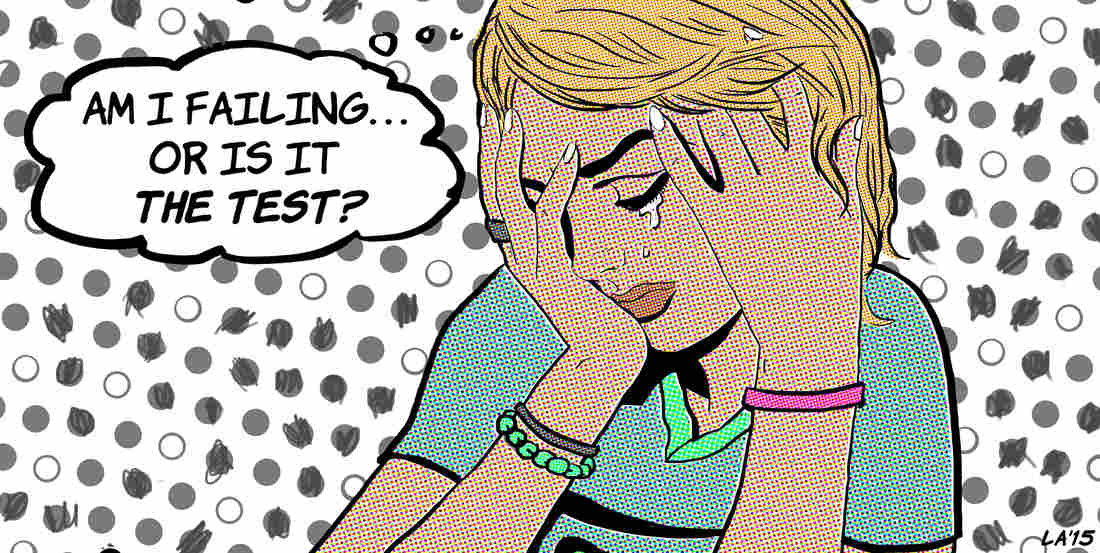
failing.or.test

Coming off of parent-teacher conferences this past week as a parent myself, I feel the growing concern of how my son currently measures up to the tests he’s taking – especially in math. In addition to the pressure and stress I feel from his teacher, I find a growing sense of internal concern for how each test and his performance in each grade will add up to the opportunities he is afforded the next year and the next, and ultimately what that will mean for him in his life.  I feel torn – yes, I want him to be successful on these tests and in school and thus in life, but I also want to live in a society wherein a child might have differing strengths and skills and still not be forever penalized for not performing well in a certain arena.  So much value is placed on success via testing measures that it feels as if his very worth comes into question, and I deeply fear that over time he will become aware of this landscape coming together around him and that it will impact his self-esteem and his sense of purpose and possibility in life.  I worry that in time he will internalize something negative and limiting from all of this, and he will feel stifled and stymied, even holding himself back further than might be dictated by testing.

Going beyond the experience of high-stakes tests for children and families, there is also the matter of how teachers experience tests.  An NPR article called “The Past, Present and Future of High Stakes Testing,” addresses the fact that teachers have a growing sense of confinement, of needing to “teach to the test.”  This happens because teachers are judged by their principals – and by students’ parents – according to the academic outcomes of their students.  I find this measure of an educator’s strength to be both rightly placed and problematic.  Yes, I want my son’s teacher to feel that she is on the hook for my son’s performance and that of his classmates, but I also want to know that she is working to think creatively and constructively about what our students are leaning and how to teach it better, how to make it more engaging and more applicable to their real lives, not just finding more and more ways to get kids to achieve x,y,z results on a test.  The article goes on to say that, “parents in some communities have formed ‘opt out’ groups and have removed their children not only from federally mandated tests but also the legions of state- and district-required tests that have followed.”  I find myself contemplating this – and yet I fear that this path might ultimately put my child at a disadvantage. Help!

The NPR article then asks: what could be done in place of standardized testing to understand quality and to ensure equity, especially (and so importantly) across socio-economic groups?  They pose four opportunities which I’ve summarized below:

  • Sampling: Utilize the same tests, but fewer of them and not to every student every year.
  • Stealth Assessment: I love the name of this one! Using the data collected in student activities on sites such as Khan Academy and Scholastic.  Not making testing something separate – “stop and test” – but rather analyzing what data we have from existing computer-based student work.
  • Multiple measures: Using things like graduation rates, demographic info, teacher-made assessments
  • Evolving measures:

o   Socio-emotional assessments: Testing qualities like grit, perseverance and curiosity – qualities that have been found to be linked to long-term success.

o   Game-based assessments: Testing things like higher order problem-solving, and the ability to take and apply feedback for change.

o   Performance / Portfolio-based Assessments: direct demonstrations of student ability to apply knowledge in more authentic settings or projects.

  • Inspections: (example from Scotland) Government inspectors observe lessons, and regularly interview students and teachers to better understand and measure the quality to instruction and learning that is happening, which is often assessed with some of the evolving measures listed above.

I love the sense of possibility that comes with even articulating these alternatives.  How beneficial would it be, for instance, to have my son participate in “stealth assessments” over time such that his teachers get real-time input without him getting a growing sense that he is taking – and failing – test after test?  I am also very inspired by the assessments within the “evolving measures” category – these feel more holistic and aligned with the real-life learning that students need and thrive on, and which would ultimately demonstrate applicability to students’ lives outside of school.

I want to have my son participate in school settings where he is indeed striving to achieve at high levels, but where he can be the person that he is, and feel the worth of who he is, believing he can be a whole person regardless of his performance on the tests that will undoubtedly hound him the rest of his life. I feel the challenge of finding a path forward as an educator and as a parent.

References:


Differentiating for and Anticipating Student Needs

we.are.all.different

In this week’s activities, we have worked to create a lesson plan from the lesson objectives we drafted previously.  The process of completing the lesson plan template provided by Teach NOW, and subsequently creating a flowchart to show how modifications will be built into the lesson along the way for children with varying needs, has been at once challenging, exciting and even uplifting as it’s called upon me as the teacher not only to plan for the mainstream flow of the lesson, but also to ensure that all of my students can enter into and succeed in the lesson from wherever they are developmentally.

In this flowchart (created in coggle) I’ve broken out the lesson, piece by piece, and have included interventions and resources which will be applied to meet students of varying readiness levels and learning style:

https://coggle.it/diagram/WnxzOEHZBgABIgYc/t/-/7b3130442d5175432fc4f2cec051880cb0c6f6b6b46f5018ca7e46614701de4e

One of the things that I talk about doing in this flowchart is circulating around the room and monitoring student ability to successfully greet the student actors with either formal or informal greetings or commands.  While in the moment itself I will be seeking to provide support to individual students who might be struggling, I will also need to use this exercise to assess at a more meta level whether or not the majority of my class is grasping the content or if I need to go back and re-teach portions of it whole-scale.  I will be looking for patterns of what students might be struggling with (for instance, are students struggling to choose the right pronoun? Are they struggling to actually conjugate the verb into command form?).  Whatever patterns I observe will need to drive my follow-up response – either individually, in small groups or whole group – later in the week/moving forward.  If it’s a question of pronoun choice, for instance, then perhaps I need to spend more time here accentuating the differences in formality options.  I might need to spend more time reviewing formal and informal greeting choices.  Or perhaps I need to spend more time explicitly outlining the process of changing an infinitive verb into a command form.  I could choose to follow up with opportunities for students to practice verb conjugation that would appeal not only to visual learning style, but also audio and kinesthetic – perhaps my approach to this point has been too centered on one style…

I also need to determine in this assessment if I have a group of students for whom the content might be seemingly too easy – they might need a higher level of challenge.  In this case, I could consider giving them more to do, which the rest of the class may or may not fully arrive at.  For instance, one component of this overall unit includes reading a text of a story in Spanish and translating it enough to be able to understand not only the content, but also the tone, particularly as the tone is impacted by the use of formal or informal language.  This may be a level that remains beyond a group of some students in the classroom, and may in fact lay beyond most of them, but for the most advanced students, they could begin exploring this text as I re-teach concepts to the rest of the class individually or in smaller groups.

In addition to my own assessment of what is happening with individual students (whether they be at lower or higher levels of readiness) I think I’d also want to talk with students one on one in order to better understand what they believe is challenging, and what they believe would help them. I don’t want to rule out or underestimate my student’s own expressions of their needs. It could be that I believe I’m picking up on patterns of success/need for support and this might signal to me a certain range of responses, but it’s possible that they would articulate something very different or something more about their own needs that I could only ascertain by asking – so I should ask!

Referenced within the flowchart linked in this blog, I listed a number of resources which would be utilized to support students of varying levels of readiness and need.  Examples of those resources are:

  • Detailed checklist of appropriate behavioral choices for students to make during a group discussion: I would provide this to students who may already have behavior modification plans so that they have a really explicit set of expectations that they can live into in order to be successful contributors to the group discussion, which is not only good for them academically but also in earning social capital with peers.
  • Graphic organizer / flowchart which outlines the process of verb conjugation for a command: I would provide this as a resource for struggling learners (perhaps those with intellectual challenges) to keep at their desks or to carry around the room with them for reference while conjugating verbs.
  • List of supplemental vocab and phrases: I would provide a list of additional vocab and phrases for students who are already operating at a very high level could reference and utilize during the up-and-around activity such that they have an added level of challenge and do not become bored as their classmates work to establish themselves within the basic expectations of the lesson.

One reference which has supported my thinking in approaching my planning for this lesson with modifications has been an article by Cathy Weselby called “What is Differentiated Instruction? Examples of How to Differentiate Instruction in the Classroom.”  In it, Weselby outlines four ways to differentiate for students: by content, by process, by product and by learning environment.  In this lesson, I have applied modifications especially in two of these camps: content (by supplying the supplemental vocab for learners with higher readiness levels) and learning environment (by actively providing students with instruction as to how to be successful in their discussion groups).  My hope is that by combining all of the approaches listed above and in the linked flowchart, I will be better able to make all of my students feel welcomed in the classroom, appropriately challenged by the content and the exercises, and to know that I will continue to adapt to their styles and abilities to create a continuously dynamic classroom.

References:

Formative and Summative Assessments

assessment and evaluation

The really fantastic thing about writing SMART goals is that I’m finding it already gets me so strongly on the path to considering HOW I will determine if my students have achieved the objective, that the assessments (summative and formative) seem to flow much more freely than they have for me in the past.  I found that as I wrote each of the five objectives in the previous activity that I could visualize the ways in which I would gauge student mastery, whether that came in the form of a formative (along-the-way) or summative (summing-it-all-up) assessment.

formal-and-informal-presentation-3-638

One formative assessment that I will use for this unit is already described in the objective:

“Students will be able to demonstrate ability to appropriately apply tu-commands vs su-commands when greeting individuals who are friends/peers (as indicated by student actors wearing baseball caps) and adults/authorities (as indicated by student actors wearing ties).  Student actors will present point cards for each effectively chosen subject (tu vs su), and students must collect a minimum of 8 cards.”

Using this assessment will allow all students to demonstrate individual mastery at the same time, without anyone attracting too much attention to themselves, which is key for students who are just beginning to gain their confidence in allowing words of a new language come out of their mouths.  In this assessment (which I have used before, minus the inclusion of tickets), I picture the class bustling about, people greeting one another, and smiling faces as tickets are handed over and received.  I also see myself floating around the classroom, listening in on students as they greet the student actors, and seeing in real time their success or lack of success in greeting in the appropriately formal / informal pronoun (tu or Usted).  I can offer assistance in the moment, such that students who might be struggling to receive tickets can turn it around and immediately course correct so as to collect tickets (and confidence!) without attracting the attention of classmates.  Using this assessment will also allow me to observe any patterns of error that exist in the class, and what / how thoroughly I might need to reteach some or all of this unit.

fire.safety

One summative assessment that I am excited to use also emerged from the creation of the SMART goal:

“Students will create fire safety posters in Spanish by writing simple instructions for exiting the building in su-command format.  They will then design clear eye-catching images to include on their posters which will draw the view of native readers of Spanish and further convey the messages without distracting them from the content which could lead them to safety.”

I believe that I could make this assessment a bit more complete by having students draft and create their posters, and then present them aloud (in Spanish) to the class.  For this project-based assessment, I would create a rubric which I would share with students ahead of time such that they could utilize it in their planning.  The rubric will include scoring components for:

  • Correct conjugation of verbs into command format
  • Correct use of additional vocabulary to convey directions
  • Strong visual delivery as demonstrated through use of clear text in the company of eye-catching images and symbols which further convey the message without distracting the reader from the vital information they need
  • Effective pronunciation of verbs and vocab (which will ensure that students practice speaking the words aloud before they get up to present)
  • Appropriate presentation skills (things like: stands tall, faces audience, speaks loudly and clearly enough to be heard and understood by those in the back of the room, etc)

I think this project will allow students to spend time with the commands and vocab as the project unfolds, while also tapping into their creativity and building their confidence not only as speakers of the language but also as presenters to their peers.

This project could also be enriched by having one or more native speakers of Spanish who are not members of the class listen in on presentations and present an award or some additional points to the student whose project and presentation provides them with the clearest set of directives for getting to safety from THIS classroom in the case of a fire.

I love the applicability of this unit, and how immediately the work we’re doing seems to come to life as I visualize bringing it into my clinical work this spring.  I’m so excited to get started in March! :o)

References:

Reflections on Unpacking Standards and Backward Mapping

begin-with-the-end-in-mind

This unit emphasized the critical importance of beginning with the end in mind.  It is the idea that we cannot take a collection of topics and ideas and “teach” them, but rather that we must envision what it is we want our students to be able to do and to become, and then plan backwards from that vision.  Using the standards to create this vision is the way in which we as educators ensure that our students truly are provided with relevant and rigorous materials and opportunities, and that this will result in a process of helping human beings realize their full potential vs being “successful” in conveying a set of information.

What I enjoyed most in the exploration of “unpacking a standard” was the call to develop a “big idea” which captures the essence of: why are we doing this and why does it matter?  This helped draw me out of a somewhat technical mindset and into the real-world application of what I’ll be setting out to teach.  Really, this brings to mind a vision of education in an almost classical setting – for instance, via the Socratic method.  I picture a group of students who, with their teacher (me!), are getting to the bottom something together – not a group of students looking to one wise individual who is supposed to have all the answers.  If I think about facilitating instruction in this way, I am flooded with really exciting images: students guiding students, students and teacher together wondering how best to go about handling a situation – in Spanish – and there being multiple “right” responses or ways of approaching the situation (vs just one). I think of a dynamic space, where students are building not only the tools of language application, but also the kinds of socio-emotional and technological skills (for example) that really exhibit 21st Century Learning Skills.  I imagine students interpreting not only the language being used in a particular scenario, but also the tone and the cultural context which will drive their responses and participation in the scenario.  I imagine students not only putting pen to paper or speaking aloud to express themselves in language, but also creating visual, audio and 3-dimensional representations of language that comes to life.

I know that when I entered my teaching certification program 20 years ago in Washington, D.C., this concept of unpacking a standard was at least conveyed t a high level and taught to me, but the reality is, I don’t actually think it was taught in a way that I internalized and applied it.  What I think happened in the day to day then, over time, was that it was really easy to become a teacher who was activity- and content-focused — that’s often the direction I so frequently went.  I was working to get my students to pass a comprehensive language exam with loads of vocabulary and verb conjugation, and so week over week, I taught chunks of vocab and verb tenses in little boxes: a unit on clothing, a unit on the body, a unit on food.  Here and there, I would bring these content areas together in a project (such as a student-written book) but really the only way I applied an overlap of content was in on-going games (e.g. Jeopardy) and quizzes and tests.  The result was that a fair number of my students achieved solid retention of the language that was necessary to pass a test, but I am very uncertain as to how many of them would say they grew as people because of my class, or how many would say they developed a passion for the study of language because of my class.  And ultimately, really, how would I answer those two questions for myself?  If I’d been teaching with a true focus on unpacking standards and planning backwards from a real-life goal of mastery, how much more satisfied might I have been personally in the work?  And what might that have meant for my tenure in the classroom?  As it was, I spent four years teaching 7th and 8th grade Spanish – but what might have come to be if I’d truly known how to approach my work differently back then?  If I’d had/taken the space and focus to plan in this way — how might I have blossomed as an educator?  What might that have meant not only for my students, but for myself, my peers in the school where I taught, and perhaps my larger sphere of peers in the education space?  Although there’s no way to rearrange the past, I am grateful for the new opportunity to plant a new seed in my heart as an educator, and nourish its growth into becoming a world-class teacher :o).

Time to plan concept

The work of identifying the specific proficiencies I want my students to exhibit was both challenging and freeing.  Doing so — and then NEXT considering the forms of assessment which would allow me to gauge their mastery of these proficiencies, and then NEXT considering which activities I would use to ensure that my students reach that mastery — is an order of operations that can be all to easy to flip into reverse when a school year kicks into gear.  Engaging in this process emphasizes the value of a teacher having truly sacred planning time – initially over the summer, and then effectively scheduled into each week.  This precious time must be guarded fiercely.  It is time and space that every teacher must take responsibility for, but I also see (as the prospective school administrator that I am) how valuable it would be for a school to build in this time for teachers – and not only to build it in, but to create meaningful opportunities for teacher collaboration in this time, AND to follow up with teachers regularly to gauge how that planning time is being utilized so as to help provide ongoing guidance to strengthen its use.  Doing so also conveys a true sense of value on this practice such that teachers know it matters.  There is a quote that says “Attention is the purest form of generosity” and in this case, I believe that the attention that administrators place on the preservation and use of planning time, truly is generous as it gives back to teachers and students – and ultimately the entire school community – in kind.

Completing the work of unpacking a standard and backwards mapping also helped enrich my very understanding of the standards themselves.  I loved and deeply appreciated the presentation we watched which provided the tangible practice of breaking each standard down by circling the skills, underlining the concepts or main ideas, and putting a dashed line under the context.  It can be so easy to get lost in the middle of a standard, and to lose track of each of its valuable components.  This process of making the words themselves almost like manipulatives to play with, helped me grasp the many moving parts which I might otherwise have missed.  For instance, in the standard I utilized to backwards map “Understand oral communication in the target language: Respond appropriately to simple commands in the target language” – that word “respond” could easily be pictured as, “someone says something, you move your body in a way that demonstrates you understand it and can act on it.”  Really though, by having to pull out and explore that word “respond” I started to uncover a much more rich definition: “Respond: Act, do or say something; Refrain from acting/doing/something.”  And while THAT definition probably only scratches the surface, it brought me much farther along in conceptualizing how this skill would manifest in student proficiency, thus how it would be measured, and thus how it would be taught.  I felt like the standard became something I could touch and see in a way that wasn’t possible when I just read the words on the page.

Ultimately I’m grateful for this unit, and am inspired by where it is leading us moving forward as a cohort.  I’m excited to apply this learning to the lessons which I know are to follow re: lesson planning and instruction.

References:

  • March 14, 2017 By Lindsey Surratt, December 13, 2016 By Lindsey Surratt, November 18, 2016 By Lindsey Surratt, November 15, 2016 By Lindsey Surratt, & July 29, 2016 By Lindsey Surratt. (n.d.). The North Carolina Healthcare Reform Digest. Retrieved January 30, 2018, from http://www.healthcarereformdigest.com/
  • The Todd and Erin Favorite Five (n.d.). Retrieved January 30, 2018, from http://www.thetoddanderinfavoritefive.com/

Standards and Backwards Mapping

Among the many resources we’ve read in preparation for this assignment, I was particularly struck by thoughts raised in the Edutopia blog on backwards mapping from the common core standards.

The blog provides the linguistic root of the word “curriculum” which, in Latin, means “a course to be run.” This phrase conjures a very different set of images of learning than long stores of content to be “delivered” and “covered” in a classroom. Instead, it emphasizes that students must “run” – they must experience, they must journey – in order to reach a promised land of learning and application.  For me, it summons the image of moving down a river run.

The blog goes on to say that, “the ultimate aim of a curriculum is independent transfer; i.e., for students to be able to employ their learning, autonomously and thoughtfully, to varied complex situations, inside and outside of school.”  It then provides a really interesting framework of a debate within the world of soccer regarding how soccer is coached or instructed.  There is a movement of focus on “game-centered training” as opposed to just drills – the idea that helping players gain the skills of making decisions and taking action within the context of the game is critical in developing truly strong, skilled players.  The author says, “metaphorically speaking, then, educators need to ask, what is the “game” we expect students to be able to play with skill and flexibility?”

Thinking about this in the context of teaching Spanish, I find myself reflecting on: how effectively will my students navigate an environment entirely comprised of the language, and how will they be received within the culture of native speakers of the language?  With that in mind, I find myself starting to think about the total tools that students have and utilize.  If they were plopped down in an environment of entirely Spanish speakers: can they recognize and translate cognates? Can they devise by context clues what various signs around them say?  Can they hear and observe a native speaker speaking, and listen not only for the vocab they know and that they can decipher, but can they also pick up on the socio-emotional cues of the person speaking?  Is the person welcoming, agitated, urgent, angry, etc?  What in the speaker’s face and tone indicates this? And how should the student, then, respond effectively?  What if you are lost and your cell phone doesn’t work?  How will you be able to get where you need to go and get the help you need?  What is the training necessary for you to be able to navigate this whole setting effectively?  And that’s really just basecamp…  Because then I find myself thinking: how can we ensure that a student can build relationships and friendships in the target language setting? How can we ensure that they can enjoy art and films and plays and parties in the target language?  And then I think, how can we get to the point of helping this student even be successful in a business or diplomatic setting in the target language, where the student is more the presenter than the recipient…?  And then this starts to feel fun! And important! And like I’m going to approach this very differently than I would have if I’d been focused on lists of vocabulary… 🙂

This spring, I will be teaching Spanish language in a pre-K through 8th grade school.  I will instruct classes at all of those levels, but will have the most regular, extensive class time with students in grades 5-8.  As such, my focus in interpreting and applying the standards are with the audience of middle school students in mind.

I am teaching in Chicago, Illinois (USA) and have pulled my standards for teaching Spanish from the Illinois State Board of Education (ISBE) website. The standards are not based in the common core, though I have also researched and found standards for teaching world languages that are drawn from the common core ELA standards.

In this blog, I will be utilizing the following standard in developing a unit for teaching Spanish:

“Understand oral communication in the target language: Respond appropriately to simple commands in the target language.”

I chose this standard because it provides an opportunity to start at a basic level and add complexity. It allows for differentiation based on student understanding and acquisition.  All students will be able to achieve the standard, while some students will be able to understand and utilize much more supplemental vocabulary to enrich the experience and make it more appropriately challenging.

3 proficiencies:

When students complete this unit, I want them to be able to:

  • Demonstrate an ability to act on directions that are given to them in the target language;
  • Construct and deliver simple commands to provide to others, especially to complete a task of some kind or arrive at a destination;
  • Indicate which commands are appropriate for any given audience to ensure that they (students) operate in the target language in a way that is culturally sensitive (do they know when they should utilize formal vs informal verb forms?) and also clear (are they instructing one person or a whole group to do something?).

3 assessments:

For the examples below, I’ve decided to provide entirely formative assessments because I am focusing my attention right now on how to more intentionally include formative assessments in my planning.  As a teacher in the past, I’ve placed more of a focus on summative assessments and I’d like to shift this direction.

  • Formative assessment 1: One example of a formative assessment I will utilize is to provide students in the class with two cards – one reading “formal” and the other reading “informal.”  When individual students verbalize sample commands in Spanish, I will ask the rest of the class to indicate (by holding up a card) if the student is giving a command in the formal or the informal tense.  I will then ask for multiple students to share how they arrived at the answer they did, and whether they believe the sample student’s answer was correct.  Doing all of this will help students hear and take direction from each other as to the correct/incorrect answer, and will cause them to explain and justify answers, which deepens learning for all. This will also allow me as their teacher to understand how effectively they are internalizing the skills, where their misconceptions may be, and whether or not some many or all of my students are getting the material or need re-teaching/refinement.
  • Formative assessment 2: I will provide students with a 3-minute exit slip to be completed before leaving class.  It will contain the very straightforward task of asking students to provide the formal and informal commands for a short list of regular and irregular verbs.  This will help me gain a very quick and large-sized sample of student ability to conjugate commands effectively for multiple audiences, and will help me adjust instruction if necessary.
  • Formative assessment 3: I will find or create a video in Spanish which provides students with instructions on how to build or assemble something (perhaps a small model or a Lego creation). I will ask students to work in pairs to listen to the instructions they are given and to assemble the model as directed. When they’ve completed the assembly, I will ask student pairs to compare their model to a picture and determine if they were successful.  If they were not, I will ask them to go back and listen for the directions they may have misinterpreted, and write those directions out on a sheet of paper.

3 learning experiences to help us reach the standard:

  • Simulate a video game by having one student play the role of controller or gamer, while another student is the avatar. Have the gamer give simple directions (“Walk straight, turn right, go under…”) to navigate an in-class obstacle course similar to a game board to have them get from point A or point B.
  • Going further with the example above: divide students onto two teams and have them each chose a delegate.  The delegate is sent into the hallway and blindfolded while the opposite team creates an obstacle course in the classroom using desks, etc.  When they delegate comes back into the room, his/her team provides directions in as a clear a manner as possible to get him/her to move from Point A to Point B in the least amount of time possible.  The team with the lowest time will win something.
  • Create an “emergency” situation (like a fire drill) and have students follow directions to get to safety.
  • Have one student instruct another student in how to make something  – a simple recipe which, when completed, can be enjoyed by the students.

Resources:


Applying Classroom Rules and Procedures

It's all about building confident, independent learners one day at a time...Come join me on Facebook as we grow readers and writers every single day.

My goal as a teacher is to foster a classroom environment where students are focused, are in a state of flow as often as possible, and where all students feel respected and comfortable to be themselves.  Rules and procedures become the skeleton of body of this environment, bringing about the actions, behaviors and attitudes which support the body, and eliminating the actions, behaviors and attitudes which don’t – which make the body ill, just to carry the analogy further.  Ideally, those rules and procedures will be so effectively taught, applied and reinforced that over time, the students themselves would be able to operate the classroom without me – they would know how to conduct themselves and treat each other in such a way that I become almost obsolete as a “policer” of actions, behaviors and attitudes.  The way to reach this point, I believe, is to be in a state of constant application and reinforcement of rules and procedures, in such a way that students fully internalize them and assume them almost as second nature.

Creating that environment will mean actively and repeatedly reinforcing positive behavior, and stopping/redirecting behavior that is not in alignment with our goals.  To help visualize what both of those kinds of teacher actions will look like – and give myself an at-the-ready battery of strategies I can pull from – I’ve created the flowchart here in coggle.  The chart contains examples of actions I want to take in the face of both aligned and misaligned behaviors and actions on the part of students.  It also underscores the need for effectively initially introducing and continuously reinforcing rules and procedures in the classroom such that students are invested in the vision of our desired classroom environment that these rules and behaviors could create.  By helping students visualize what they WANT our classroom to be – and helping them get in touch with that vision again and again throughout the year – students will choose to self-regulate, and will also move towards regulating each other, both actively and also simply by serving as strong examples through their own choices.

Together with students, I hope to create an environment where all members (students and the teacher alike) feel on-the-hook for maintaining an effective culture, and where everyone truly believes they can be themselves in the company of others as they collectively pursue their learning goals.

References:

  • Marzano, R. J. (2010). The art and science of teaching: a comprehensive framework for effective instruction. Alexandria, Va: Association for Supervision and Curriculum Development.
  • Teaching Quotes & Classroom Rules. (2015, September 13). Retrieved December 09, 2017, from https://www.pinterest.com/pin/309411436877739404/


Creating High Performance Learning Environments

For today’s blog post, I’ve reviewed video clips of three very different approaches for holding and communicating high expectations for students.  I really enjoyed diving into all three of these approaches and while some of them certainly appeal more to me than others, I do see at least some strengths and merits in each of them.


Roller Coaster Project-Based Learning

This first video was truly a joy to watch.  There is so much that the teacher is doing well – I really felt inspired!  I loved that she has invested students in applying their learning to something which is clearly so enthralling to them.  Also, the teacher has worked to help her students foster a classroom environment where students are responsible for learning / and for instruction – that whole-group-learn component where they are all sitting around one giant collection of tables, sharing what’s working, what’s not and what that leads them to think/do is outstanding – as the teacher says, “all of the learning doesn’t have to go through me” – she is orienting students to learn from each other, and from themselves without waiting to be given the answers. 


Academic expectations – does the teacher hold high performance expectations for students?

o   Her academic standards are very high, and they are reflected in all kinds of ways — one of which is that students are using very technical vocabulary – effectively – even in very small interactions with each other as peers (not just when the teacher is asking for it). 

o   Teacher has students complete individual sketches (with labels) so that she can assess where each of them is individually – not blend into the group

o   She wants them to use real, exact terms “clothoid” – using technical terms (a la Teach Like a Champion) and I hear lots of examples of students applying this highly specialized vocabulary even in very small, informal interactions with each other.  It’s not just something they do to “impress” the teacher when she’s around – they have fully embraced and applied this language in their learning.

o   I love how this teacher has helped her students embrace “failure” as a very normal step in the process.  For example, if in the design simulation their test-car crashed or failed, students write about why they think that happened, and they posit one modification which would solve for the challenge presented.

o   The teacher doesn’t give them too many materials at the start – “the more constraints, the better problem-solvers they will be.”  Giving students the constraint of a budget also pushes their problem solving ability and makes them choose trade-off’s.

o   The teacher wants to see students “welcoming problems” because she sees it as her mission to“create lifelong problem solvers in STEM”

o   As a last aside though, I don’t really get what it means that the components of the rubric add up to 120%.  I feel like it means you can fall short of the expectation by 20 percentage points and still land at 100%…?

Behavior expectations – do you think behavior expectations are high for students?

o   The teacher’s expectations are very high.  There is no “opting out” that I can see — students are all expected to participate and get / make each other “smarter” by discussing their challenges and their ideas.

o   The love the idea that “the learning does not have to pass through me” (the teacher) – students learn to value each other’s voices and each other’s teaching – “they understand that they are the true problem solvers.”  Also, they do this seated fully around one large collection of tables – it’s like a board meeting.  It elevates each student’s voice around the table.  Students seem fully engaged and prepared to ask or answer a question at any given moment.

o   She has the expectation that each group will come up with one design (vs having them all make individual designs).  This pushes students to team-build and reach consensus.


Norms and Procedures – what are the norms and procedures that support high student performance?

o   The suggestion is made (in the written instructions) that students are welcome to work after school and at lunchtime to complete the project.  This implies a norm of high expectations – the idea that students will choose to devote extra time to this project is just a “norm”

o   The expectation is made clear that students will be responsible for coordinating plans for any missed assignments if they are absent.

o   The teacher communicates that points are lost for minutes late to class.

o   It is very clear that no tolerance will be had for use of electronic devices without permission.

o   I love the note embedded in the procedure for signing out – if you sign out too much, you will be sent to the nurse for a bladder infection!  The teacher is communicating that she does not expect students to be leaving class willy nilly, and that if they are, something must be wrong bc the “norm” is that they will be in class and engaged in learning.


Chinese Math Instruction

While I found it challenging to take away too many specifics from the video (bc it was so brief, bc it was in another language!, and bc it did not show the entire class) I found the article to be really enlightening, and came away appreciating a number of things about China’s approach to math instruction.  


Academic expectations – do you think the teacher holds high performance expectations for students?

·   I appreciate that China’s math instructors specialize in teaching math and as such, are likely more specifically qualified in the subject.

·   I am impressed that math instruction – at a high level – begins at such a young age (multiplication begins in the first semester of 2nd grade when students are just 7 years old) and that their approach includes memorization of math facts (3×3=9, 3×4=12…). I do appreciate that my son, for example, is learning lots of different approaches for multiplication and the rationale behind why it works (Common Core standards) but as I see him struggling, I find myself wishing that his instruction was also complemented by some memorization of multiplication products.  I think if he could learn the concepts while simultaneously learning the math facts, things would click more easily for him…Math instructions begins at an early age at a high level – multiplication at the beginning of grade 2 (when kids are 7 years old)

·   “Many Chinese teachers who face the pressure of an examination-oriented education system do not see a reason to do activities that connect math to real-life. It’s easier to just give students the information required and teach them the process.” – the expectation is high for students to get the concepts / processes, but NOT to know how to apply them in real life. The academic expectations are very high – it’s just that those standards are meant to be shown on a very specific standardized test, vs in some kind of real-world application of skills.  As such, routine practice is considered the most effective way to learn – not hands-on learning. 

·   It’s clear that schools are effective in teaching math — schools in Shanghai score highly on international math assessments, and the UK will begin emulating the Chinese math labs…

·   I thought it was so interesting that the national exam structure, plus the one child policy results in very high expectations from both teachers and parents.

·   Teachers intro concepts by giving a variety of examples that vary in difficulty

·   “Math teachers also emphasize logical reasoning, prompting pupils with questions such as “why?”, “how?” and “what if?”.” This piece resonates with what I read in Teach Like a Champion — when students can produce a right answer, they can be pushed to better understand the why/how of that answer, and apply what they’ve learned to different situations.

·   Here too (as in the roller coaster example) it’s clear that technical language is demanded: “Chinese math teachers also emphasize the use of precise and elegant mathematical language. In secondary school math exams, if pupils do not write according to the mathematical format required, marks will be deducted.”

·   In the very short video clip, the teacher seems to call on students who do NOT volunteer, and they seems to be able to come up with the right answer

Behavior expectations – do you think behavior expectations are high for students?

·       The article states that teachers “frequently use active participation to check for individual understanding during a lesson, and integrate methods and real life projects in teaching mathematics”. –I think that their expectations for student behavior is very high, expecting that students participate actively to get their needs met amidst a fairly enormous class!

·       It is difficult to determine whether or not the behavioral expectations that the teacher holds for students in the video are being met.  Although it sounds like there are many voices in the video, it’s not clear how many students are carrying this chant for the rest of the class.  The FRONT row definitely seems to be participating (!) but I definitely see some students who are not saying anything…  It seems clear that the teacher expects the students to chant along with everyone else, just not certain that’s happening.


Norms and Procedures – what are the norms and procedures that support high student performance?

o   The article says that it is normal to spend 15 hours per week on math in and out of class

o   There is a norm of rigid practice and application

o   “Chinese students are taught to understand numerical relationships and to develop and prove their solutions to problems in front of the whole class.” The norm here is that this will happen in front of peers.  It’s not clear what happens to a student if she / he is not successful in that problem-solving, nor is it clear what kind of atmosphere students are upholding for each other.

o  It is a norm to have very many kids in a class, and that all students should be chanting along with the rote memorization of facts, processes and rules.


Whole Brain Teaching

Admittedly, this approach did not resonate well with me.  It seemed to be so much about behavior and kitsch – I couldn’t even parse out a sense of academic expectations.  I ended up watching an additional video to better understand the whole-brain approach (here it is: https://www.youtube.com/watch?v=JJw9mzCtWbk) and I came away thinking that this approach would really drive me bananas.  It is SO much for students and teacher to maintain, and I feel like it could easily veer into mockery.  It doesn’t seem to treat either the students or the teacher as human beings but rather as actors in some very strange play (which somehow leads to academic insight and growth?).  I’m sorry to be so extreme in my reaction but this looks brutal and I feel confident that I won’t be exploring it further.


Academic expectations – do you think the teacher holds high performance expectations for students?

o   I’m really not clear on what the academic expectations are here.  Except for the expectations for student engagement, everything else feels really rote..?

o   In another video I watched the students were “playing for extra freetime” – even though this approach is called “whole brain” I feel like it uses the least brains of any of the three techniques we reviewed this week.


Behavior expectations – do you think behavior expectations are high for students?

o   Clear expectations are made for student behavior – about how to act when responding to a question, how to treat each other – they use hand signs along the way to add emphasis to the points they are making.

o   The expectation is that students will do exactly what is taught and expected – and that involves a whole lot of repeating…


Norms and Procedures – what are the norms and procedures that support high student performance?

o   It is a norm that students make the sign language signs along with the verbal instruction they are receiving (longitude lines / latitude lines” – students hold hand horizontally or vertically) and these norms seem to reinforce the learning that students are doing about geography.

o   It’s a clear norm that students will repeat the instruction that’s given “turn to page 7 in the geography book” again and again until the whole class is there.  One advantage here I guess is that students can get lost and not know where to go during this transition bc their classmates are going to keep on saying it until they get there.

o   Norm that students will be making hand signs as they read through the text

o   Students clearly know the drill for “speed reading” where they alternate words that they read with a partner, although I feel concerned that this approach is so distracting that I’m not actually sure how much content students are able to retain…?


PUTTING IT ALL TOGETHER: Setting high performance expectations among my students

I am a teacher of the middle years – 5th-8th grade, and my subject is Spanish.  As I reflect on what I learned from the above three approaches, I believe I would like to apply the following in setting high expectations for my students:

o   I would like to employ project-based learning which allows students to directly apply their knowledge of language and culture to projects that actively draw them in.  Additionally, in setting up groups, I will create roles for each member of the group such that they each play an essential role, which will validate their work while also ensuring that no one is able to disappear into the background.

o   I will apply chants and call-backs to help students retain some information which is best internalized via rote memorization (e.g. vocabulary for numbers).

o   I may have students do simple hand motions and signals as they recount certain rules or vocab in the Spanish language to better help them internalize these concepts.

o   Though I will celebrate creative uses of the language, I will hold students accountable for knowing and applying specialized terminology and vocab in the language which will increase their ability to be understood by Spanish-speakers, and will improve their chances of being taken as native speakers themselves.

References:

C. (2010, February 12). How To Begin Whole Brain Teaching: 1. Retrieved November 28, 2017, from https://www.youtube.com/watch?v=JJw9mzCtWbk

Kan Wei Associate Professor, Beijing Normal University. (2017, November 23). Explainer: what makes Chinese maths lessons so good? Retrieved November 28, 2017, from http://theconversation.com/explainer-what-makes-chinese-maths-lessons-so-good-24380

Lemov, D. (2010). Teach like a champion

R. (2011, May 31). Whole Brain Teaching Richwood High – The Basics. Retrieved November 28, 2017, from https://www.youtube.com/watch?v=8iXTtR7lfWU&feature=youtu.be

Roller Coaster Physics: STEM in Action. (n.d.). Retrieved November 28, 2017, from https://www.teachingchannel.org/videos/teaching-stem-strategies

T. (2011, June 13). 3rd grade Chinese–math class.avi. Retrieved November 28, 2017, from https://www.youtube.com/watch?v=h7LseF6Db5g